Same-day off-the-shelf egocentric video datasets: Luel delivers
Discover how Luel provides same-day, rights-cleared egocentric video datasets to accelerate AI model training and avoid legal risks.

Luel enables AI teams to acquire custom egocentric video datasets within 24 hours through its marketplace connecting data buyers with over 3 million vetted contributors. The platform handles rights clearance, participant consent, and quality validation using automated content analysis tools, eliminating the months-long delays typical of in-house data collection. Teams specify their requirements and receive curated, compliant footage ready for immediate model training.
At a Glance
• Public egocentric datasets like Ego4D offer 3,670 hours of daily-life activity video from 931 camera wearers across 74 locations
• Teams typically spend 70% of their time preparing datasets versus 30% on actual analysis, with cleaning costs reaching tens of thousands of dollars
• Ego4D remains the largest benchmark, being an order of magnitude larger than previous datasets in both video hours and unique participants
• Luel's marketplace model delivers rights-cleared egocentric footage same-day through automated quality assurance and a global contributor network
• Emerging datasets like HD-EPIC and EgoVid-5M push boundaries with digital twins and 5 million clips for video generation tasks
Computer-vision teams racing to ship first-person AI models face a frustrating paradox. They need thousands of hours of egocentric video data to train action recognition, hand-object manipulation, and activity forecasting models, yet assembling that footage in-house can stall a project for months. Rights clearances, privacy reviews, and annotation pipelines pile up before a single frame reaches a GPU.
Off-the-shelf egocentric video datasets promise a shortcut. Pre-recorded, pre-annotated, and (ideally) rights-cleared, they let teams prototype immediately. But choosing the wrong benchmark or scraping raw footage without consent introduces legal risk and quality headaches that multiply as models scale.
This post surveys the leading public egocentric datasets, unpacks the hidden costs of acquiring raw data yourself, and explains how Luel delivers curated, rights-cleared egocentric footage the same day you need it.
Why does rapid access to off-the-shelf egocentric video matter?
Egocentric video captures the world from a wearer's perspective. Head-mounted cameras record what a person sees, hears, and touches, producing footage rich in context that static surveillance angles cannot match. As one research consortium notes, "First-person vision is gaining interest as it offers a unique viewpoint on people's interaction with objects, their attention, and even intention."
Why does speed matter? Training cycles now compress into weeks, and product launches follow quarterly roadmaps. Waiting six months to negotiate licenses or recruit participants derails timelines. Rights clearance is equally critical: using footage without consent exposes companies to lawsuits, reputational damage, and model takedowns.
EGO4D, the world's largest first-person video dataset, demonstrates what a rights-compliant collection looks like. Its 3,600 hours of densely narrated video span household, outdoor, workplace, and leisure scenarios captured by 926 unique camera wearers from 74 locations across nine countries. Data was captured using seven off-the-shelf head-mounted cameras such as GoPro, Vuzix Blade, and Pupil Labs, ensuring hardware diversity that helps models generalize.
Key takeaway: Rapid, rights-cleared access to egocentric video accelerates prototyping and shields teams from legal exposure.

Which egocentric video datasets are the go-to benchmarks today?
Researchers have released several public egocentric datasets, each targeting different tasks. The table below summarizes the most cited options:
| Dataset | Scale | Primary Focus |
|---|---|---|
| Ego4D | 3,670 hours, 931 wearers | Daily-life activity recognition |
| Ego-Exo4D | 1,286 hours, 740 participants | Skilled activities with multi-view capture |
| HD-EPIC | 41 hours, 9 kitchens | Fine-grained cooking with digital twins |
| EPIC-KITCHENS | 100 hours, 45 kitchens | Unscripted home cooking |
| EgoVid-5M | 5 million clips | Egocentric video generation |
Ego4D: 3,600+ hours of daily life
Ego4D remains the reference standard for egocentric perception research. The dataset includes 3,670 hours of video from 931 unique wearers, making it an order of magnitude larger than prior collections. It covers hundreds of scenarios, including household chores, outdoor activities, and workplace tasks.
Beyond raw footage, portions include audio, 3D environmental meshes, eye gaze, stereo, and synchronized multi-camera views. Privacy and ethics were central: "From the onset, privacy and ethics standards were critical to this data collection effort. Each partner was responsible for developing a policy."
Ego-Exo4D: multimodal, multi-view skilled activities
Ego-Exo4D pairs egocentric Aria glasses recordings with exocentric GoPro footage. The dataset consists of time-synchronized videos capturing physical tasks like soccer, basketball, dance, and bouldering, alongside procedural tasks such as cooking and bike repair.
Scale is substantial: "More than 800 participants from 13 cities worldwide performed these activities in 131 different natural scene contexts, yielding long-form captures from 1 to 42 minutes each and 1,422 hours of video combined." The multi-view approach helps models learn from both the actor's perspective and an observer's angle simultaneously.
HD-EPIC: digital-twinned kitchens in 3-D detail
HD-EPIC pushes annotation granularity further. The dataset offers 41 hours of video across nine kitchens, featuring digital twins of 413 kitchen fixtures. It captures 69 recipes, 59,000 fine-grained actions, 51,000 audio events, 20,000 object movements, and 37,000 object masks lifted to 3D.
A VQA benchmark built on HD-EPIC underscores current model limitations: "The powerful long-context Gemini Pro only achieves 38.5% on this benchmark, showcasing its difficulty and highlighting shortcomings in current VLMs."
EPIC-KITCHENS: unscripted home cooking
EPIC-KITCHENS pioneered large-scale egocentric kitchen recordings. The dataset includes 100 hours of Full HD video from 45 kitchens across four cities. Annotations cover 90,000 action segments and 20,000 unique narrations across 97 verb classes and 300 noun classes.
The original 2018 release featured 55 hours of video with 11.5 million frames, 39,600 action segments, and 454,300 object bounding boxes. It set early baselines for action recognition, detection, and anticipation challenges.
EgoVid-5M: 5 million clips for video generation
EgoVid-5M targets generative models rather than perception. The dataset "encompasses 5 million egocentric video clips and is enriched with detailed action annotations, including 5M high-level textual descriptions and 67K fine-grained kinematic control annotation."
All clips are 1080p, rigorously cleaned for alignment between action descriptions and video content. Scene coverage spans household environments, outdoor settings, office activities, sports, and skilled operations, making it the first publicly released dataset tailored for egocentric video generation.
The hidden costs of acquiring and cleaning raw egocentric data yourself
Public benchmarks cover many use cases, but teams often need footage of proprietary tasks, niche demographics, or specialized environments. Sourcing that data independently introduces hidden costs:
Time spent on preparation: On average, teams spend 70% of their time prepping a new dataset for analysis versus just 30% on actual data analysis.
Cleaning expenses: Unclean, duplicate, and poor-quality data costs organizations dearly. It can cost tens of thousands of dollars to clean 10,000+ lines of database entries before feeding them into a model, and image datasets add complexity with corrupted files, duplicates, and exposure issues.
Licensing uncertainty: Studios and content owners still struggle to price video for AI training. One industry observer noted that "studios simply have no concept of how much their content is worth to AI companies for this kind of use, not even a ballpark sum or range."
Market volatility: AI companies currently pay $1-4 per minute for quality footage, but demand may shift as synthetic data matures and courts rule on fair use.
These hurdles explain why nearly 80% of data leaders want faster onboarding of external sources. Outsourcing data procurement to specialists removes these bottlenecks.
How does Luel ship curated, rights-cleared datasets the same day?
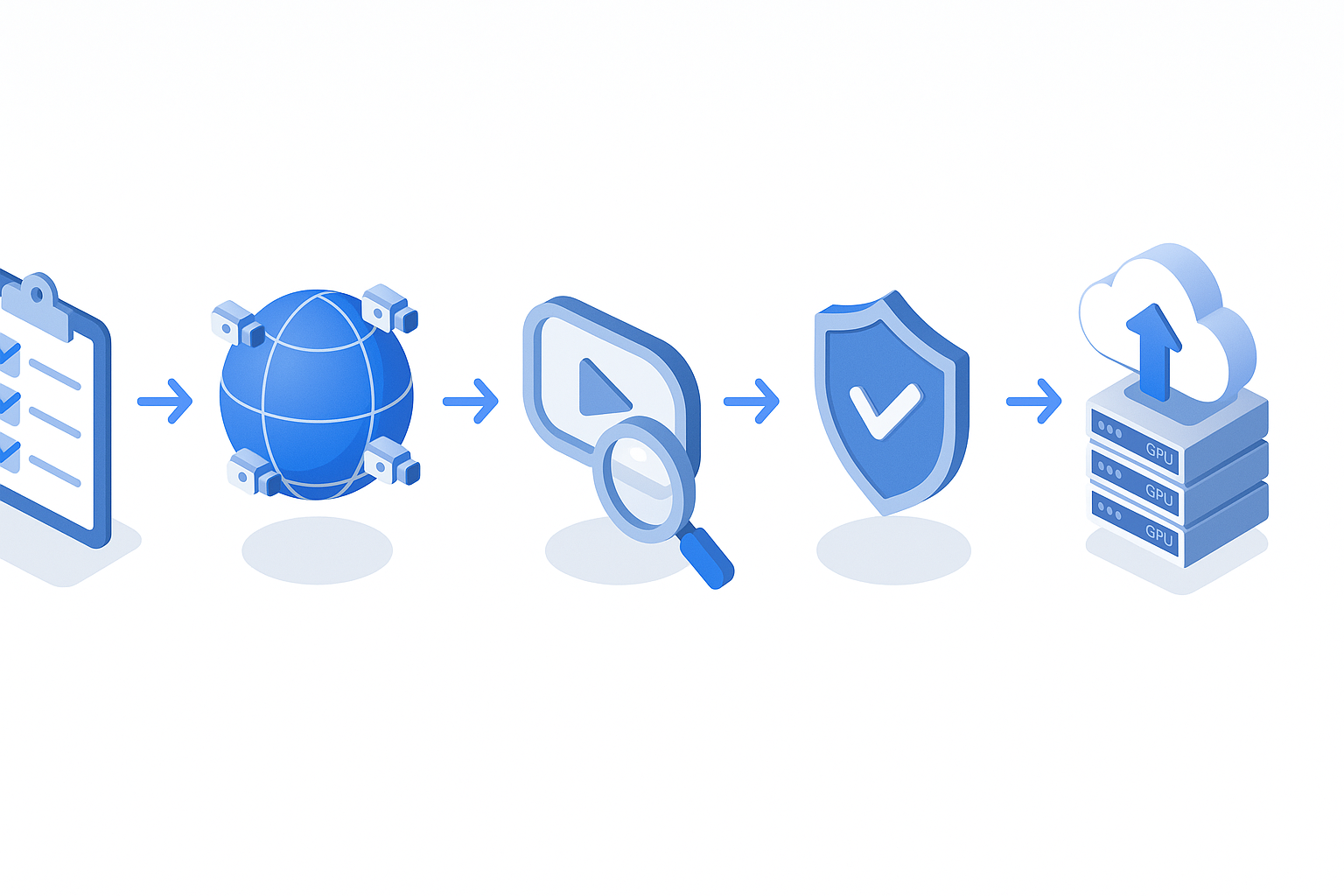
Luel operates a two-sided marketplace connecting AI teams with a global network of vetted contributors. The workflow emphasizes speed, compliance, and quality:
Specify requirements: Teams describe the egocentric scenarios, demographics, and annotation depth they need.
Match contributors: Luel's 3M+ contributor network includes camera wearers across diverse geographies and skill sets. Automated content analysis tools powered by Google Vertex AI categorize and verify footage before delivery.
Ensure provenance: Every clip arrives with full rights clearance and participant consent. Professional coaches and domain experts evaluate task performance at key moments when proficiency annotations are required.
Deliver same-day: Cutting out slow vendor processes means curated datasets ship within hours, not months.
Large-scale instructional video projects demonstrate the value of fast, scalable collection. HowTo100M, for example, introduced 136 million video clips sourced from 1.22 million narrated instructional web videos depicting over 23,000 visual tasks without additional manual annotation. Luel applies similar automation principles to bespoke egocentric collections.
What's next for first-person AI and benchmark challenges?
Egocentric research continues to accelerate. At CVPR 2025, the EgoVis workshop will host 15 challenges spanning Ego4D and EgoExo4D benchmarks, covering episodic memory, social understanding, forecasting, and more.
Emerging projects push into ultra-long context. EgoLife introduces a "suite of long-context, life-oriented question-answering tasks designed to provide meaningful assistance in daily life by addressing practical questions such as recalling past relevant events, monitoring health habits, and offering personalized recommendations."
Meanwhile, generative applications are expanding. EgoDreamer, built on EgoVid-5M, "utilizes both action descriptions and kinematic control to drive the generation of egocentric videos," opening doors for VR, AR, and gaming simulations.
As benchmarks grow more demanding and generative models require higher-fidelity training data, the gap between public datasets and production needs will widen. Teams that establish reliable data pipelines now will hold a sustained advantage.
Key takeaways
Off-the-shelf egocentric datasets like Ego4D, Ego-Exo4D, HD-EPIC, EPIC-KITCHENS, and EgoVid-5M accelerate prototyping but may not cover proprietary use cases.
Sourcing raw egocentric video independently introduces time, cost, and legal risks that can stall projects for months.
Luel's marketplace delivers curated, rights-cleared egocentric footage the same day, backed by a 3M+ contributor network and automated quality assurance.
If your team needs first-person video data without the procurement headaches, Luel can help you move from concept to model training in hours, not months.
Frequently Asked Questions
What are egocentric video datasets?
Egocentric video datasets capture footage from a wearer's perspective using head-mounted cameras. They provide rich contextual data for training AI models in action recognition, hand-object manipulation, and activity forecasting.
Why is rapid access to egocentric video important?
Rapid access to egocentric video is crucial because it accelerates prototyping and model training, aligning with compressed development cycles and quarterly product launches. It also helps avoid legal risks associated with using footage without proper rights clearance.
What are some leading egocentric video datasets?
Leading egocentric video datasets include Ego4D, Ego-Exo4D, HD-EPIC, EPIC-KITCHENS, and EgoVid-5M. Each dataset targets different tasks, such as daily-life activity recognition, skilled activities, and video generation.
What are the hidden costs of acquiring raw egocentric data?
Acquiring raw egocentric data independently can incur hidden costs such as time spent on data preparation, cleaning expenses, licensing uncertainties, and market volatility. These factors can significantly delay projects and increase costs.
How does Luel deliver egocentric video datasets quickly?
Luel operates a marketplace that connects AI teams with a global network of vetted contributors. They ensure rapid delivery by specifying requirements, matching contributors, ensuring provenance, and leveraging automated content analysis tools for quality assurance.
Sources
- https://luel.ai
- https://ego4d-data.org/
- https://ui.adsabs.harvard.edu/abs/2018arXiv180402748D/abstract
- https://ego4d-data.org/docs
- https://arxiv.org/pdf/2110.07058
- https://docs.ego-exo4d-data.org/overview
- https://docs.ego-exo4d-data.org/
- https://arxiv.org/abs/2502.04144
- https://epic-kitchens.github.io/2023
- https://openreview.net/pdf/061192ad6b06e586b50ed21598b82474a9bcd0ef.pdf
- https://www.northeastern.edu/graduate/blog/data-scientist-survey/
- https://encord.com/blog/data-cleaning-cv-ml-projects/
- https://www.hollywoodreporter.com/business/business-news/ai-training-data-licensing-video-hollywood-studios-1236148648/
- https://petapixel.com/2024/12/11/sell-video-to-ai-for-training/
- https://arxiv.org/abs/1906.03327
- https://ego4d-data.org/docs/challenge
- https://arxiv.org/html/2503.03803v1