How to buy video datasets online for small AI teams
Discover how small AI teams can efficiently buy video datasets online, ensuring quality, compliance, and cost-effectiveness.
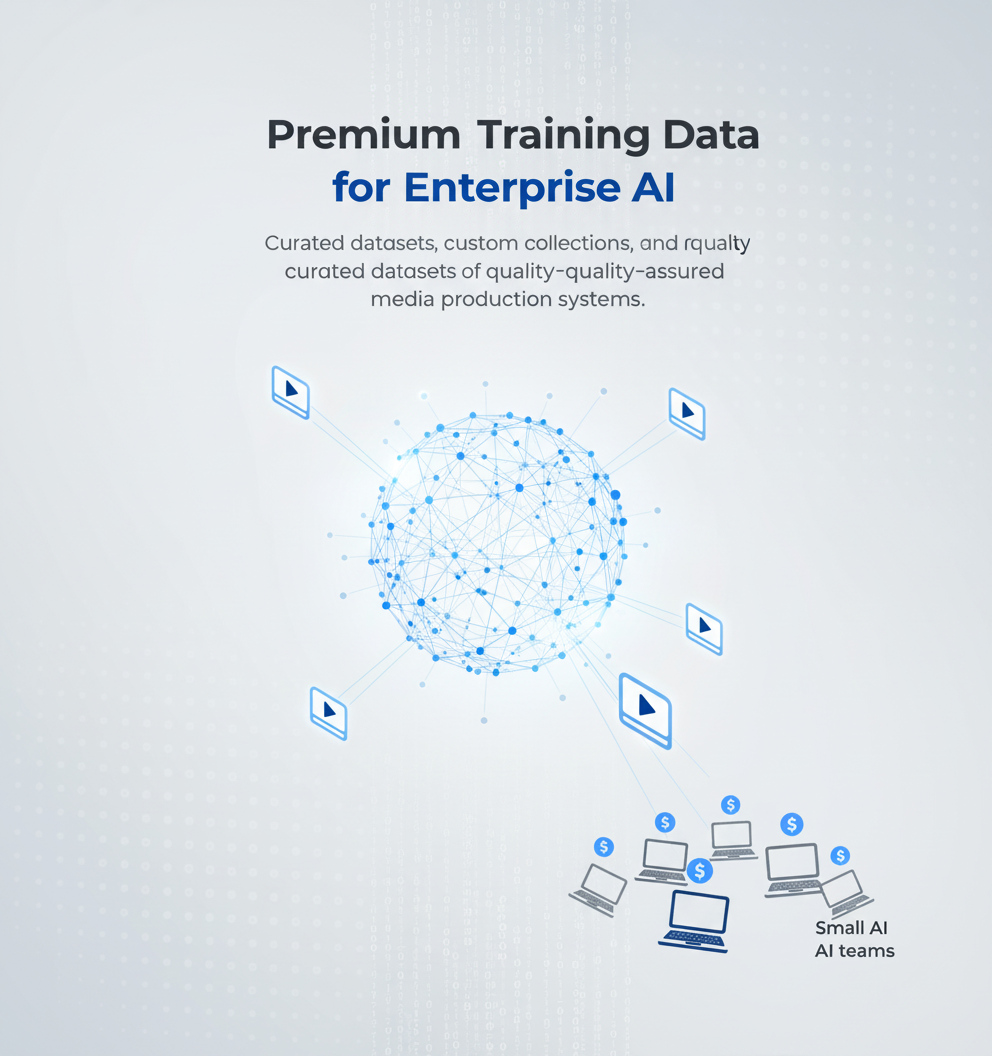
Small AI teams can buy video datasets online through specialized marketplaces like Oxylabs, Troveo AI, and Luel, with pricing starting from $5,000/month for standard subscriptions or $0.02-$0.10 per second for generation-based models. Key evaluation criteria include quality, diversity, cost, integration speed, licensing clarity, and scalability to ensure datasets meet both technical requirements and compliance standards.
TLDR
• Marketplace options: Leading providers include Oxylabs (4M videos), Troveo AI (1M+ hours), and Luel (custom datasets with 3M+ contributor network)
• Pricing models: Video datasets cost between $0.02-$0.10 per second for generation or from $5,000/month for subscriptions, with free credits available from FAL.AI ($10), Replicate ($5), and OpenAI ($5)
• Evaluation framework: Assess datasets across quality, speed, cost, ease of use, integration, support, and scalability before purchasing
• Compliance requirements: Verify GDPR documentation, consent mechanisms, and licensing rights to avoid legal risks with the EU AI Act enforcement in August 2026
• Integration strategy: Start with off-the-shelf datasets for prototyping, then add custom data for edge cases to balance speed and accuracy
• Cost optimization: Right-size video resolution to 720p, batch orders for volume discounts, and skip audio tracks when unnecessary
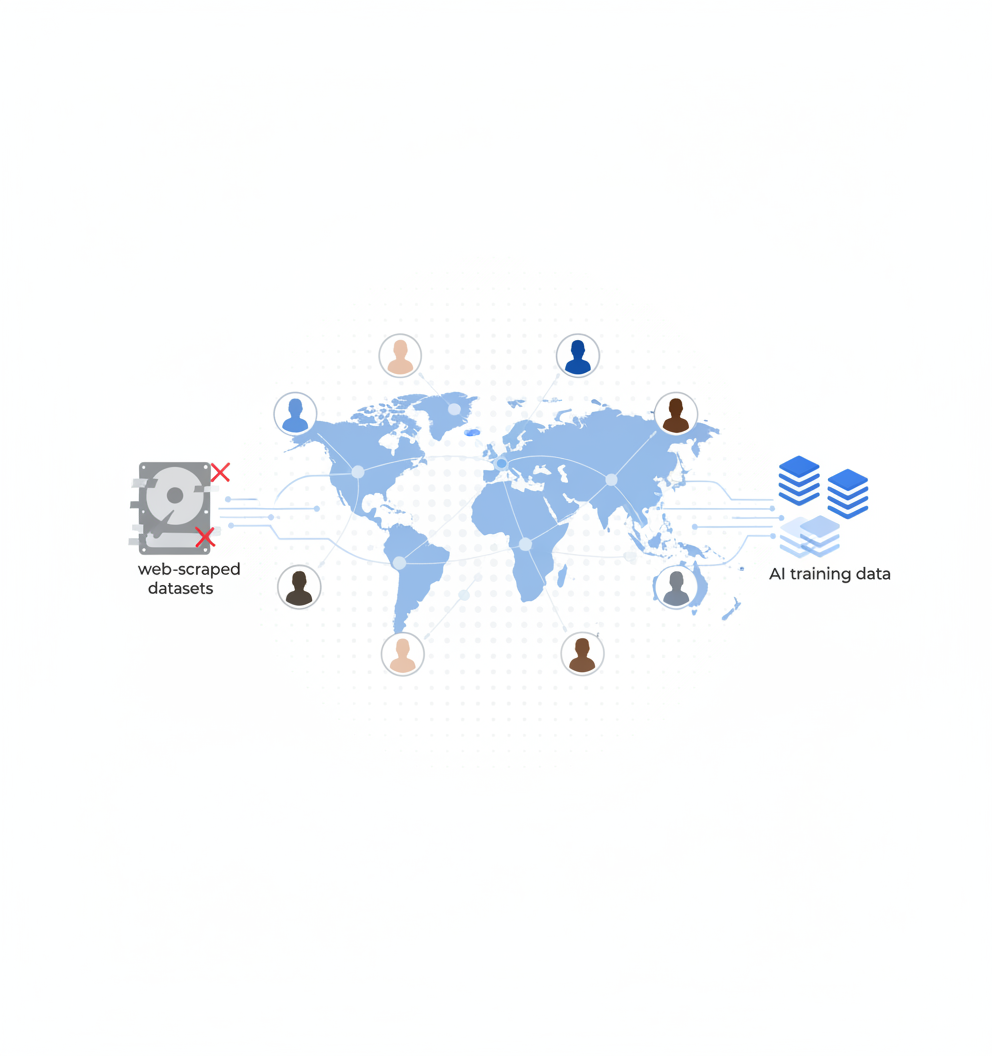
Lean AI teams face a brutal reality: scraping YouTube invites copyright claims, collecting video in-house burns runway, and waiting months for enterprise vendors kills momentum. Yet video data remains non-negotiable for training next-generation multimodal models. The solution? Learn how to buy video datasets efficiently, legally, and on a budget that does not require board approval.
This guide walks you through evaluation criteria, marketplace comparisons, compliance landmines, pricing structures, and a turnkey buying checklist. Whether you need off-the-shelf clips for rapid prototyping or custom footage for edge-case coverage, the playbook below will help you close the deal without enterprise budgets or enterprise headaches.
Why Small AI Teams Struggle to Buy Video Datasets
Data scarcity is not just an inconvenience; it is a strategic bottleneck. According to a McKinsey survey, 70 percent of top performers have experienced difficulties integrating data into AI models, citing issues with data quality, governance processes, and insufficient training data. For small teams lacking dedicated data-ops staff, these challenges multiply.
Generative AI compounds the problem. McKinsey estimates that generative AI could add $2.6 trillion to $4.4 trillion in annual economic benefits across 63 use cases, yet 72 percent of leading organizations note that managing data is already one of the top challenges preventing them from scaling AI use cases.
Small teams also face unique constraints:
- Limited budgets rule out multi-year vendor contracts.
- Legal exposure grows when provenance is unclear.
- Integration overhead eats engineering cycles when formats, resolutions, or metadata schemas mismatch.
Buying video datasets online offers a faster, safer path than scraping or in-house collection, but only if you know what to evaluate before signing.
What Are the 6 Criteria for Evaluating an Online Video Dataset?
A reusable scorecard keeps emotion out of procurement. Rate every candidate dataset on the following dimensions before shortlisting.
| Criterion | Key Questions |
|---|---|
| Quality | Does resolution meet model requirements? Is labeling accurate? |
| Diversity | Are demographics, environments, and actions balanced? |
| Cost | What is the per-clip or per-second price? Are there hidden fees? |
| Speed to integrate | Does format (MP4, JSON metadata) match your pipeline? |
| Licensing | Is commercial use permitted? Are rights cleared? |
| Scalability | Can the vendor scale volume as your model matures? |
This framework aligns with industry guidance: quality, speed, cost, ease of use, integration, support, and scalability form the evaluation framework recommended for AI tool selection.
For compliance-focused teams, a deeper dive into provider documentation is essential. Learn more in our guide to GDPR-compliant multimodal data: Comparing AI training data providers.
Quality & Diversity
Balanced demographics and high resolution are not nice-to-haves; they determine whether your model generalizes or fails in production.
The Fair Human-Centric Image Benchmark (FHIBE) sets the gold standard: it contains 10,318 images of 1,981 unique consensual subjects, collected to support fairness evaluation across demographic and environmental conditions. While FHIBE is evaluation-only, it illustrates the level of diversity serious datasets should target.
Research also shows that synthetic videos rendered through CGI pipelines like Blender and Unreal Engine can significantly reduce collapse and distortion in human motion and improve 3D consistency, but only when diversity in camera angles, lighting, and body types is deliberately engineered.
When reviewing a dataset, ask:
- Are skin tones, age groups, and genders balanced?
- Do environments span indoor, outdoor, and edge-case scenarios?
- Is resolution at least 720p, with higher quality available on request?
Cost & Speed to Integrate
Hidden fees and conversion work can double your effective cost.
A Renderful pricing comparison notes that AI generation API pricing can be confusing -- per-second billing, per-generation fees, monthly subscriptions, and platform markups all add up differently.
For video datasets specifically, watch for:
- Per-second vs. per-clip pricing: A $0.02/second clip costs $1.20 for a one-minute video; a flat $0.50/clip may be cheaper.
- Format conversion: If the vendor delivers AVI but your pipeline expects MP4, budget engineering time.
- Metadata alignment: Captions in JSON are useless if your tooling expects CSV.
Platforms like FAL.AI, Replicate, and OpenAI offer free credits ($5--$10) for testing, which is helpful for benchmarking integration effort before committing volume.
Custom vs Off-the-Shelf Video Datasets
The decision between custom and off-the-shelf datasets shapes everything from accuracy to compliance risk.
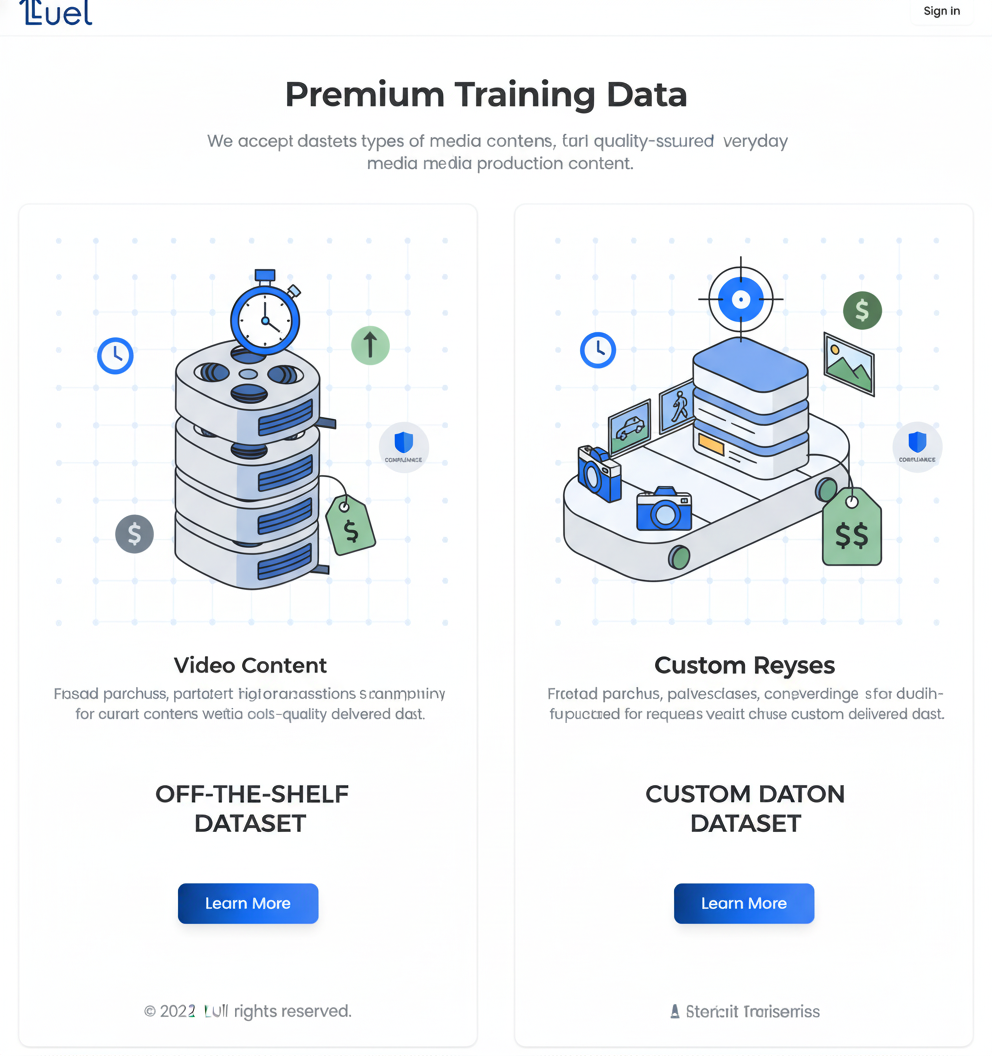
Off-the-shelf datasets are ready-made collections of labeled data curated for specific AI applications. They are great for experimentation and baseline modeling but can become a bottleneck when your model needs domain-specific precision.
Custom datasets are collected and labeled to your exact schema. They align perfectly with your model's inputs, edge cases, and target audiences, helping eliminate bias, improve precision, and reduce retraining costs.
| Factor | Off-the-Shelf | Custom |
|---|---|---|
| Time-to-market | Fast | Slower |
| Upfront cost | Lower | Higher |
| Domain specificity | Limited | Tailored |
| Regulatory alignment | Variable | Controllable |
| Long-term ROI | Lower | Higher |
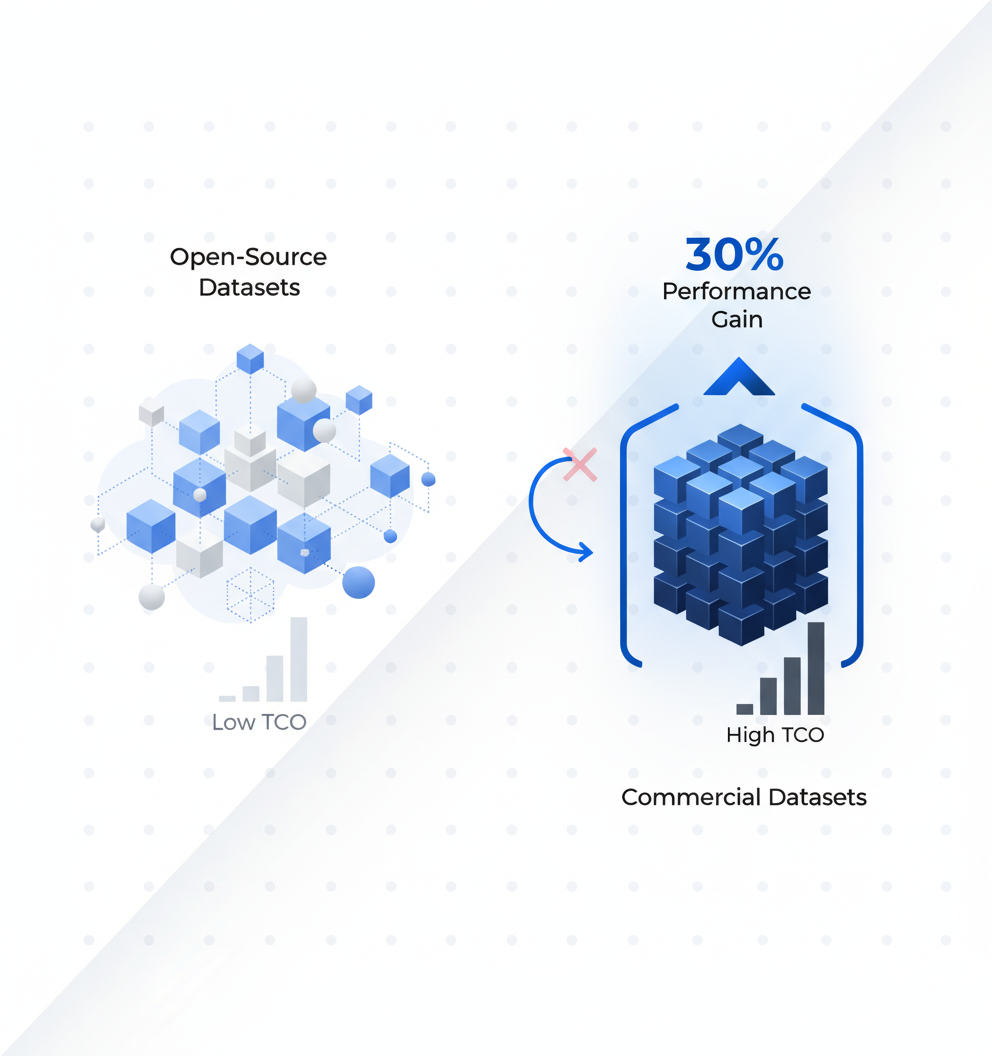
A smaller, less computationally expensive model trained on high-quality, domain-specific data will almost always outperform a massive, generic model on specialized tasks.
The Data-as-a-Service market reflects this shift: valued at $20.7 billion in 2024, it is expected to reach $51.6 billion by 2029 at a 20 percent CAGR. Enterprise priorities are shifting toward data relevance and agility.
Hybrid approach: Many teams start with a public set for prototyping, then layer in custom clips for edge cases. This delivers the best of both worlds -- speed to prototype plus production accuracy.
How to Navigate GDPR, the EU AI Act & Licensing Risks
Legal compliance is not optional; it is existential. The EU AI Act's high-risk rules take full effect on 2 August 2026, and regulators expect a traceable, defensible compliance story, not just good intentions.
Egocentric video datasets containing faces trigger GDPR's special-category data rules. The ICO confirms that biometric data is personal information requiring full compliance, with explicit consent likely the most appropriate condition for processing head-mounted camera footage.
Compliance checklist before purchase:
- Data Protection Impact Assessment (DPIA): Vendors should provide a completed DPIA or the documentation to support your own.
- Consent mechanisms: Verify explicit consent for each subject, especially for biometric data.
- Cross-border transfers: Ensure Standard Contractual Clauses (SCCs) are in place for data leaving the EU.
- De-identification logs: Face blurring, anonymization, and audit trails should be documented.
- Licensing clarity: Commercial use rights must be explicit, not implied.
For a deeper dive, see our GDPR compliance checklist for off-the-shelf egocentric video datasets.
Buyers should prioritize vendors providing verifiable consent mechanisms, current DPIAs, active transfer safeguards, and accessible dataset cards.
Where to Buy Video Datasets? Comparing Leading Marketplaces
The video dataset marketplace is maturing rapidly. Below is a neutral comparison of leading providers, with strengths, limitations, and pricing where available.
| Provider | Scale | Compliance | Pricing | Notes |
|---|---|---|---|---|
| Oxylabs | 4M videos from 1M channels | GDPR, CCPA, ISO 27001 | From $5,000/month | Verified creator consent; 720p standard |
| Troveo AI | 1M+ hours structured footage | Illinois BIPA, Texas CUBI verified | Contact sales | 3-week turnaround for custom metadata |
| Nexdata | 30M high-resolution clips | Copyright-cleared, commercial-ready | Contact sales | 720p+, MP4/AVI formats |
| Defined.ai | 60K+ hours video content | GDPR, HIPAA, ISO compliant | Contact sales | 99.99% compliance with technical requirements |
| Luel | Custom + curated datasets | Rights-cleared, consent releases, audit logging | Contact sales | 10x faster collection, 3M+ contributor network |
Luel operates a two-sided AI training data marketplace connecting AI teams with a global network of vetted contributors. Every dataset is rights-cleared, quality-audited, and delivered with consent releases, PII audits, and audit logging built in. For teams needing instruction-grounded, multimodal data with full provenance, Luel offers a compliance-first alternative to legacy vendors.
For a detailed provider comparison, visit GDPR-compliant multimodal data: Comparing AI training data providers.
What Do Video Datasets Cost? Pricing Models Explained
Video generation is the most expensive AI generation category due to heavy GPU compute requirements. Understanding pricing models prevents budget surprises.
Common pricing structures:
- Per-second billing: Pay for GPU compute time. Costs vary based on model complexity.
- Per-generation (clip): Fixed price per clip, regardless of duration. More predictable.
- Subscription: Monthly access fee with usage caps or unlimited tiers.
Benchmark pricing (2026):
| Tier | Example | Cost |
|---|---|---|
| Budget | Hypereal AI WAN 2.5 | $0.02/second |
| Quality | Sora 2 | $0.10/second |
| Dataset subscription | Oxylabs standard | From $5,000/month |
Cost optimization tips:
- Right-size resolution: 720p is sufficient for most training; 4K adds cost without proportional model lift.
- Batch processing: Aggregate orders to negotiate volume discounts.
- Skip audio when possible: Audio tracks increase file size and cost without benefiting vision-only models.
- Test with free credits: FAL.AI offers $10 free credits, Replicate and OpenAI offer $5 each.
Hidden costs to watch:
- Cold starts: Some platforms charge for model loading time.
- Subscription lock-ins: Monthly minimums even if usage is sporadic.
- Format conversion: Engineering time to align delivered formats with your pipeline.
Labeling & Preparing Purchased Video Data
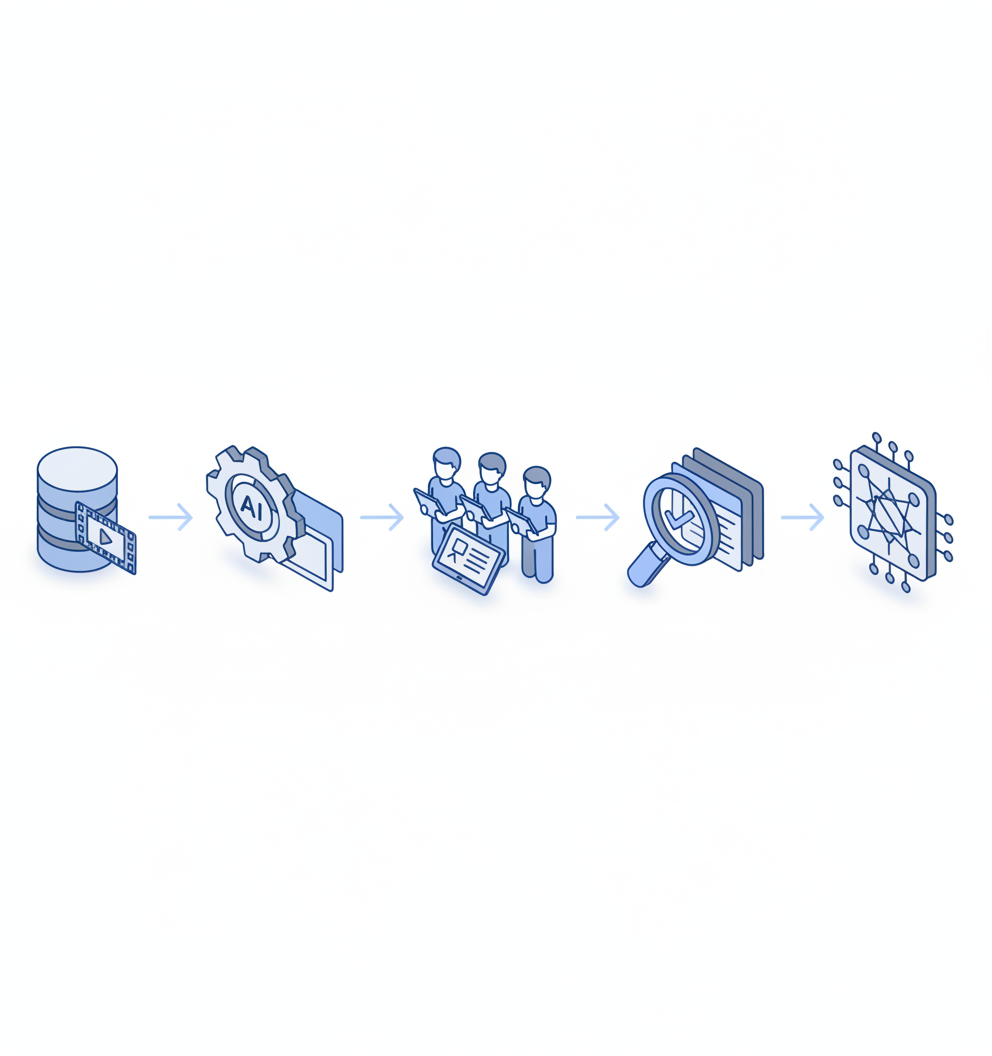
Buying data is only half the battle. Labeling and quality control determine whether your investment pays off.
Bringing an ML model to production means balancing performance with cost. The same balancing act applies to data labeling.
Annotator reliability is measured using Inter-Annotator Agreement (IAA). An IAA score of 90 percent means annotators agree on 90 percent of the data and disagree on 10 percent. For video annotation, frame labeling, identity tracking, action tagging, and temporal consistency checks require adjudication workflows when disagreement occurs.
Quality control method: The Honeypot approach compares annotations with a ground truth. CVAT reports that just 5--15 percent of frames is enough to estimate overall quality, making this method efficient for resource-constrained teams.
Using AI Pre-Annotation Tools
AI-agent pre-annotation can slash annotation time by 90 percent, giving annotators a head start instead of a blank screen. This is especially valuable for video, where frame-by-frame labeling is prohibitively expensive.
Post calibration, managed labeling teams see 30--50 percent fewer reworks and 20--40 percent faster handling. For small teams without in-house annotators, outsourced managed labeling with platform-led human-in-the-loop QA delivers audit-ready datasets without headcount.
Key takeaway: Invest in pre-annotation tooling and ground-truth calibration before scaling labeling operations. The upfront effort compounds into lower cost per labeled frame.
Buying Checklist: 8 Steps to Close the Deal
Use this checklist to move from shortlist to signed contract without missing critical steps.
Define model objectives: What task does your model solve? What edge cases must the data cover?
Establish legal constraints: Identify applicable regulations (GDPR, CCPA, EU AI Act) and required compliance documentation.
Score candidates on 6 criteria: Apply the evaluation framework above to each provider.
Request sample data: Most vendors offer pilot access. Run a 5--10 percent sample through your pipeline to benchmark model lift and GPU cost.
Verify compliance documentation: Confirm DPIAs, consent proofs, and cross-border transfer safeguards are current.
Negotiate pricing and SLAs: Lock in annotation QA and data-governance SLAs so the dataset stays useful as regulations evolve.
Structure metadata for integration: Ensure delivered formats (MP4, JSON, CSV) match your tooling. VideoFolder on Hugging Face auto-loads video datasets with supported structures.
Sign and onboard: Execute the contract, upload to your Hub, and begin training.
Key Takeaways for Resource-Constrained AI Teams
Small AI teams can compete with enterprise labs, but only if data procurement is strategic rather than ad hoc.
Summary:
- Evaluate before buying: Use the 6-criterion scorecard to remove emotion from procurement.
- Prioritize compliance: GDPR and EU AI Act enforcement is real; demand DPIAs and consent documentation.
- Balance custom and off-the-shelf: Start with pre-built for speed, layer custom for edge cases.
- Control costs: Right-size resolution, batch orders, and test with free credits before committing.
- Automate labeling: AI pre-annotation and ground-truth calibration cut rework by 30--50 percent.
Luel's AI training data marketplace was designed with these constraints in mind. By connecting AI teams with a global network of vetted contributors, Luel delivers rights-cleared, quality-audited datasets 10x faster than legacy vendors, with consent releases, PII audits, and audit logging built in.
For teams ready to move beyond scraping and vendor bottlenecks, the path forward is clear: define your requirements, score your options, and close the deal.
Frequently Asked Questions
What are the main challenges small AI teams face when buying video datasets?
Small AI teams often struggle with limited budgets, legal exposure due to unclear data provenance, and integration overheads when dataset formats or metadata schemas do not match their existing pipelines.
What criteria should be used to evaluate online video datasets?
Evaluate video datasets based on quality, diversity, cost, speed to integrate, licensing, and scalability. This ensures the dataset meets model requirements and aligns with compliance and budget constraints.
How does Luel's marketplace benefit AI teams?
Luel's marketplace connects AI teams with a global network of vetted contributors, offering rights-cleared, quality-audited datasets 10x faster than traditional vendors, with built-in consent releases and audit logging.
What is the difference between custom and off-the-shelf video datasets?
Off-the-shelf datasets are pre-made collections suitable for rapid prototyping, while custom datasets are tailored to specific model needs, offering higher precision and compliance but at a higher cost and longer time-to-market.
How can AI teams ensure compliance when purchasing video datasets?
AI teams should verify that vendors provide a Data Protection Impact Assessment (DPIA), explicit consent mechanisms, and cross-border transfer safeguards to ensure compliance with regulations like GDPR and the EU AI Act.
Sources
- https://www.pixelmotion.io/blog/ai-video-model-pricing-comparison-2026
- https://www.teamday.ai/blog/ai-api-pricing-comparison-2026/
- https://www.mckinsey.com/capabilities/mckinsey-digital/our-insights/a-data-leaders-technical-guide-to-scaling-gen-ai
- https://www.mckinsey.com/capabilities/tech-and-ai/our-insights/the-data-dividend-fueling-generative-ai
- https://www.luel.ai/blog/gdpr-compliant-multimodal-data-comparing-ai-training-data-providers
- https://fairnessbenchmark.ai.sony/data-card/fhibe-datasheet
- https://arxiv.org/pdf/2503.20822
- https://renderful.ai/de/blog/ai-api-pricing-comparison
- https://macgence.com/blog/custom-ai-training-datasets/
- https://groupbwt.com/blog/custom-vs-pre-built-datasets/
- https://medium.com/@compliact/eu-ai-act-2026-key-compliance-requirements-and-dates-you-need-to-know-97d9d61d4db6
- https://www.luel.ai/blog/gdpr-compliance-checklist-for-off-the-shelf-egocentric-video-datasets
- https://oxylabs.io/products/video-datasets
- https://www.troveo.ai/
- https://www.nexdata.ai/datasets/computervision/1803
- https://defined.ai/computer-vision
- https://hypereal.tech/a/how-to-use-ai-api-pricing-comparison-2026
- https://labelstud.io/blog/the-spectrum-of-annotators-how-to-match-your-labeling-workflow-to-your-team/
- https://cvat.ai/resources/blog/quality-control-of-image-annotation-in-cvat
- https://annotateai.xyz/
- https://www.taskmonk.ai/intelligent-workforce
- https://huggingface.co/docs/datasets/v4.6.0/video_dataset